From Sunday Rib to Sourdough: Five Sheffield Blades for the British Kitchen

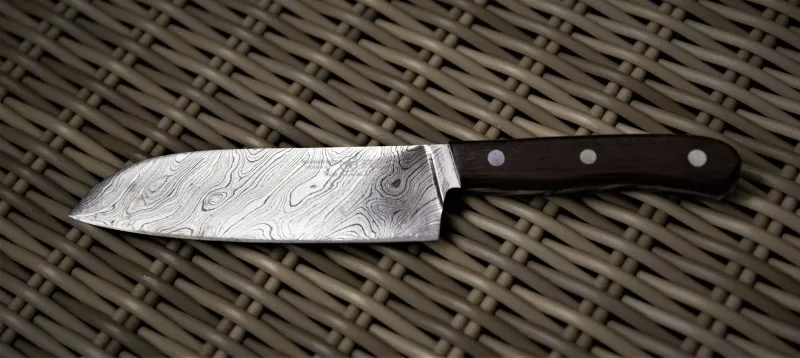
Photo: Anthospace, CC BY 4.0, via Wikimedia Commons
British home cooking is not a single cuisine. It is a set of recurring jobs: the Sunday joint, the roast potatoes, the fish pie, the sourdough loaf and the weekly pile of vegetables. A knife collection built around those tasks will be more useful than one built around catalogue categories. The five Sheffield profiles below are not a mandatory set. They are a way of matching blade shape to work, and of deciding where a specialist knife is genuinely worth the space.
1. The carving knife for the Sunday roast
A roast is a slicing job, not a chopping job. The blade needs length enough to draw through the joint in one clean stroke, and a narrow profile that can follow the grain without tearing the crust. A 20cm to 23cm carving knife is the traditional answer. Look for a blade with a little flex and a fine, even grind behind the edge. A hollow-ground or Granton-style face can help release sticky slices, though a well-honed plain blade is perfectly capable.
Steel choice matters less here than geometry. A stainless steel in the middle of the hardness range will resist the acids in gravy and the occasional resting juices. A carbon steel blade will take a keener edge but demands drying and a little oil. For most UK kitchens, stainless is the sensible default.
Where one blade can do two jobs: a 20cm cook's knife will carve a small chicken or a boned shoulder, but it struggles with a large rib of beef. If you roast most weeks, the carving knife is a specialist worth owning. If you roast occasionally, borrow the length from a cook's knife and accept a less tidy slice.
2. The 20cm cook's knife for roast potatoes and general work
Roast potatoes are a test of confidence. The potato must be cut into even pieces, and the knife must move through dense, cooked flesh without wedging. A 20cm cook's knife with a sturdy heel and a slight convex grind is the most useful single blade in a British kitchen. It can break down a chicken, slice a cabbage, crush garlic and portion the potatoes before they go into the fat.
Length matters. An 18cm blade is nimble but short for a large cabbage; a 23cm blade is efficient but can feel unwieldy on a small board. Twenty centimetres is the honest compromise. The grind should be thin enough behind the edge to cut cleanly, but not so thin that the edge chips when it meets a roast potato that has cooled and hardened.
Where one blade can do two jobs: this is the blade that replaces most others. It will carve a small joint, slice a loaf in an emergency and handle the bulk of vegetable prep. Buy it first, and buy it well.
3. The flexible fillet knife for fish pie
Fish pie is not a demanding dish, but its preparation rewards the right blade. If you buy whole fish, a flexible fillet knife of 15cm to 18cm makes short work of removing skin and separating fillets. The flexibility lets the blade follow the backbone without gouging. The thin grind reduces resistance through soft flesh. A stainless steel is preferable for fish, partly for corrosion resistance and partly for the ease of cleaning after contact with salt and juices.
If you buy pre-filleted fish, the specialist argument weakens. A 12cm utility knife or a small cook's knife can break up fillets for a pie. The fillet knife earns its place when you buy whole fish regularly, or when you poach and skin fish for a sauce. It is a narrow, single-purpose tool, and it should be chosen for flexibility rather than length alone.
Where one blade can do two jobs: a flexible boning knife can fillet fish and bone poultry, but it is not a substitute for a cook's knife. Keep it if you cook fish more than once a fortnight; otherwise borrow the utility knife.
4. The bread knife for sourdough
Sourdough is the reason a bread knife still belongs in a British kitchen. The crust is hard and the crumb is soft, and a plain edge will crush the loaf before it cuts it. A serrated bread knife of 20cm to 25cm, with scalloped teeth rather than needle points, will saw through the crust and then glide through the interior. The blade should be long enough to span the loaf and stiff enough not to wander.
Steel is less critical here than tooth geometry. A stainless blade is practical and easy to maintain. Avoid a serrated knife that is too short; it will saw unevenly and leave a ragged slice. A offset handle can be useful for clearance, though it is not essential.
Where one blade can do two jobs: a bread knife is poor at almost everything else. Do not use it for tomatoes or jointing. It is a specialist, and it earns its place if you bake or buy whole loaves. If you only buy sliced bread, skip it.
5. The paring knife for bulk vegetable prep
Bulk vegetable prep is not one task but many: topping and tailing, peeling, shallots, garlic, small trims. A 9cm to 10cm paring knife gives control that a cook's knife cannot match at the board's edge. The blade should be short, rigid and thin behind the edge. A plain edge is more versatile than a serrated one for this work.
A 12cm to 15cm utility knife is the alternative for those who prefer a slightly longer blade. It can peel, slice and trim, and it sits comfortably between paring and cook's knife. For a small kitchen, the utility knife may be the more sensible purchase.
Where one blade can do two jobs: a paring knife can open packets, trim pastry and peel fruit, but it cannot replace a cook's knife for volume. It is a support blade, not a workhorse.
Matching steel and grind to the British kitchen
Most UK kitchens will be best served by stainless steel. It tolerates a damp climate, irregular drying and the occasional lapse in care. Carbon steel is for the cook who enjoys maintenance and accepts that a grey patina is part of the bargain. Grind matters more than steel for most home cooks: a thin edge cuts well but needs care; a sturdier edge lasts longer but can wedge in dense vegetables.
Handle choice should follow the same logic. Riveted scales can be repaired; moulded handles usually cannot. If the knife is to last, buy one that can be rehandled.
Building the set in the right order
Start with the cook's knife. Add the paring knife. Add the bread knife if you bake or buy whole loaves. Add the carving knife if the Sunday roast is a regular event. Add the fillet knife last, and only if whole fish is a habit. That order reflects real use rather than catalogue completeness.
A Sheffield knife is not made more useful by being part of a matching set. It is made useful by fitting the work in front of it. Five profiles, honestly chosen, will cover the British kitchen better than a block of fifteen that never leave the drawer.