Where the Money Goes: A Pound-by-Pound Anatomy of a £250 Sheffield Kitchen Knife
Sheffield has been arguing about the price of an edge for four centuries. The Company of Cutlers in Hallamshire was established by Act of Parliament in 1624 precisely to settle questions of mark, standard and worth, and the argument has not really stopped since. What has changed is the buyer's distance from the bench. A household ordering a knife online in 2026 sees a number and a photograph, and very little in between.
What follows is an attempt to show the working. The figures are an illustrative model, not one workshop's accounts, but they are built from the ordinary costs of small-batch knife production in the city: bar stock, batch heat treatment, abrasive belts, bench hours and the quiet arithmetic of rent and electricity. Where ranges appear, they reflect the spread between a plain working knife and one built with expensive handle material.
Starting at the billet
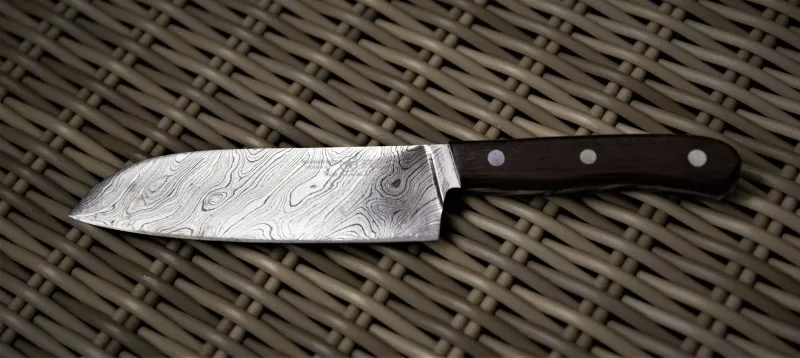
A 20cm chef's knife begins as a bar of steel perhaps 300mm long, 50mm wide and 2.5mm thick. Common choices among Sheffield bench makers include SF100, 14C28N, Nitro-V and, for the traditionalists, a carbon steel such as O1. Allowing for wastage at the tang and the profile, expect £12–£16 of steel per blade.
Profiling follows. A waterjet batch costs roughly £3–£5 per blade once twenty or so blanks are cut at once; a bandsaw and a pillar drill cost less in cash and considerably more in time. Either way the blank must be squared, drilled for pins and, on a tapered tang, thinned before the grinder ever runs.
The heat treatment nobody sees
Most small makers send blades out in batches to a specialist treaters, which is the sensible arrangement: a controlled furnace and a calibrated tempering cycle are expensive things to own. A batch of twenty blades might cost £60–£90, before the maker's own time wrapping in stainless foil, plate quenching and running three temper cycles. Spread across the batch, that is £7–£11 per knife.
It is the least visible money in the build and the most consequential. A blade that is over-heated at the grind or under-tempered at the oven will not hold an edge, no matter how handsome the handle, and the whole downstream cost is wasted. Buyers rarely ask about heat treatment. They should.
Hours at the bench
The largest single line on the bill is grinding, and it is the line buyers most often underestimate. A 20cm chef's knife requires rough profiling, establishment of the bevels, a distal taper, a clean plunge line and then a sequence of grits from coarse ceramic through to a hand-rubbed finish. Two to three hours is a realistic figure for a well-ground blade; a thin, high-performance grind takes longer, and a mistake takes longest of all.
At a self-employed rate of £25 an hour — well below what a plumber or an electrician charges in Sheffield, and a rate that must absorb holidays, sick days and administration — that is £50–£75 of labour per knife. Anyone who has watched a maker chase a grind line under a work lamp will recognise the figure as modest rather than inflated.
Handle, fit and finish
Handle materials range from stabilised beech and G10 at the lower end to desert ironwood, bog oak or horn at the upper. Scales, pins, liners and epoxy come to £12–£35. Shaping, sanding through the grits, easing the shoulders and finishing the handle takes 1.5–2 hours, or £38–£52, plus the occasional piece that splits and is started again.
After that come the small items that make the difference between a knife and a finished product: final honing and edge verification (£8–£14), belts, abrasives, epoxy, pins and protective oil (£5–£8), and packaging that will survive a courier (£4–£7).
The workshop's quiet share
Overheads are the least romantic part of the story and the hardest to explain at a craft fair. A bench in a shared Sheffield workshop runs perhaps £200–£400 a month; grinders and compressors draw serious current; insurance, public liability and tool depreciation all accrue whether or not anyone is buying. Allocated per knife across a realistic annual output, that is £9–£15.
| Line | Low | High |
|---|---|---|
| Steel and blank preparation | £12 | £16 |
| Profiling and drilling | £3 | £5 |
| Heat treatment, including maker's time | £7 | £11 |
| Grinding and hand finishing | £50 | £75 |
| Handle materials | £12 | £35 |
| Handle fitting and finishing | £38 | £52 |
| Honing, marking and inspection | £8 | £14 |
| Consumables | £5 | £8 |
| Overhead allocation | £9 | £15 |
| Packaging | £4 | £7 |
| Direct cost | £148 | £238 |
A typical mid-range build lands somewhere around £170–£200. That leaves £50–£80 on a £250 direct sale to cover photography, marketing, website costs, warranty, resharpening support and, eventually, profit.
The retail chain and the taxman
Here the arithmetic becomes uncomfortable. Most specialist retailers work to a keystone or slightly better margin, buying at 50–60 per cent of the recommended retail price. A £250 knife in a shop window therefore returns the maker roughly £125–£150 — below the direct cost of the build.
That is the quiet reason so many bench makers now sell direct, with waiting lists and a deposit. It is also why a £250 knife on a shop shelf tends to mean one of four things: a larger batch, a plainer handle, fewer grinding hours, or a maker absorbing a loss to be seen in the right company.
Then there is VAT. A £250 price inclusive of VAT contains £41.67 for the Exchequer, leaving £208.33 net. A maker trading below the registration threshold keeps that sum; one who has crossed it does not. It is a strange cliff edge in a trade built on small volumes.
The £40 import on the same page
It is worth being fair to the supermarket knife. Its steel arrives as coil costing pennies per blade; the blank is stamped in a fraction of a second; the grind is applied by a robot to a fixed geometry; the handle is moulded around the tang; heat treatment is a continuous conveyor process with tight statistical control. A landed cost of £8–£12 is plausible, and a £40 retail price includes £6.67 of VAT and a retailer's margin that still works because the tooling and design costs are spread over hundreds of thousands of units.
That is not a con. It is a different set of economics, and for many kitchens it is entirely adequate.
What the extra money actually buys
What the Sheffield buyer is paying for, when the sums are done honestly, is geometry that can be maintained rather than replaced, steel and heat treatment that behave predictably over decades, a grind thin enough to cut properly and stout enough to survive a home cook, and a named person answerable for the edge. It also buys the possibility of repair — a new handle, a regrind, a knife that outlives its owner's enthusiasm for shopping.
What it does not buy is a guarantee. A £250 knife with a clumsy grind and an indifferent heat treatment is £250 wasted, and the price tag will not tell you which you have. That is why the useful question at the counter is not 'why is it so expensive' but 'which line on the bill am I paying for'. A maker who can answer that, plainly and without romance, is usually the one worth buying from.