The Case Against the Matching Block: A Sheffield Kitchen Built Blade by Blade

Photo: individual Sheffield kitchen knives on wooden counter mixed handles close up, via wallpapers.com
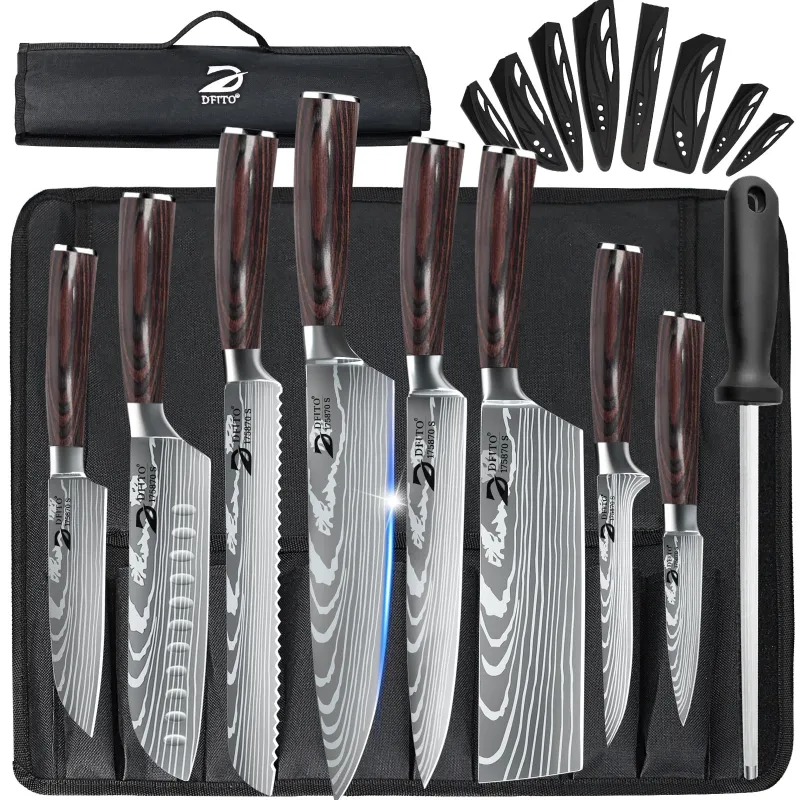
Walk into many British kitchens and the first object to catch the eye is often the knife block: six slots filled, handles aligned, a neat piece of retail theatre sitting on the worktop. It looks reassuring. It suggests preparedness. Yet a kitchen is not a showroom, and the matching block is frequently a promise the room cannot keep. The case for buying Sheffield cutlery one piece at a time is not a case against beauty or order. It is a case for a kitchen that earns its tools through use, repair and gradual accumulation rather than accepting a boxed answer chosen by someone else.
The block solves a problem the cook does not have
A matched set is sold on completeness. In practice, completeness is rarely the difficulty. Most domestic cooks need a small number of knives that perform distinct tasks well: a cook's knife that feels secure in the hand, a smaller blade for detail, a serrated edge for bread and tomatoes, perhaps a carving knife for the Sunday joint. A boxed set often supplies several near-duplicates while economising on the pieces that matter. The result is a drawer or block filled with instruments that are present but not persuasive.
There is also a question of provenance. When knives are bought as a set, the weakest item is hidden behind the strongest. The buyer inherits a single brand promise rather than a series of specific judgements about steel, grind, heat treatment and handle construction. Sheffield's small workshops are not best understood through the logic of the matched block. They are best understood through individual blades, each with a maker's mark, a steel specification and a reason for existing.
What single purchases do for small benches
Sheffield cutlery has always depended on a chain of specialised hands: steelmakers, forgers, grinders, handle-makers, assemblers, sharpeners. The modern small workshop is not a factory in miniature. It is a fragile arrangement of skill, equipment and cash flow. A customer who buys one knife today and another in eighteen months is not merely spreading the cost. That customer is giving the bench a steadier signal than a single large order routed through a retailer.
Individual sales also keep repair in view. A knife bought as part of a set is often treated as a disposable unit; a knife bought deliberately is more likely to be returned for sharpening, a new handle or a corrected edge. That relationship matters in 2026, when the economics of small-scale manufacturing in the UK leave little room for throwaway production. Repairability is not a sentimental extra. It is part of the value of a well-made blade.
A working kitchen accumulates evidence
A serious kitchen is rarely coherent in the manner of a catalogue. It accumulates. A cook buys a knife for a task, learns its habits, and later buys another because the first has exposed a genuine gap. This is not untidiness. It is evidence of use.
The practical sequence matters more than the brand. Begin with the blade that does most of the work, usually a cook's knife of 20cm to 23cm, chosen for balance rather than spectacle. Add a serrated knife only when bread, tomatoes or delicate crusts make the case. A small paring knife earns its place through frequent small tasks, not through matching the set. A carving knife should arrive when there is a joint to carve, not because a block has an empty slot.
Buying in this way also allows the cook to notice what a Sheffield blade is doing. Is the edge holding? Is the handle comfortable after twenty minutes? Does the steel respond well to a honing rod or require a different routine? These are questions that emerge from use, and they are more useful than the assurances printed on a box.
Making mismatched pieces cohere
The obvious objection is visual. A kitchen built from different purchases can look like an accident. It need not. Coherence comes from a small number of repeated notes, not from identical handles.
First, choose a common scale. A set of knives that all feel roughly similar in weight and handle girth will read as a family even when the finishes differ. Second, repeat one material or colour. If the cook's knife has an oak handle, a second knife in walnut can still belong if the ferrule or bolster echoes the first. Third, distinguish deliberate difference from carelessness. A carbon steel blade with a dark patina sitting beside a stainless blade with a satin finish can look intentional if the handles share a simple, unornamented language. It looks careless when the kitchen contains a chrome showpiece, a neon plastic handle and a rustic forged blade with no visual relationship between them.
Era is less troublesome than finish. A mid-century Sheffield blade and a contemporary bench-made knife can sit together well if both are honest working tools. The problem is not age; it is affectation. Avoid buying a knife because it completes a period look. Buy it because the geometry, steel and handle suit the hand.
The 2026 arithmetic
The financial argument for buying singly is not that it is cheap. It is that it is legible. A £250 Sheffield kitchen knife represents steel, labour, grinding, handle work, finishing, overheads, retail margin and tax. Spread across several purchases, the cost is easier to judge and easier to absorb. It also makes the buyer less willing to accept a weak item simply because it came in a handsome box.
In the current UK market, the buyer should ask what happens after purchase. Can the knife be sharpened locally? Can the handle be replaced? Is the maker or retailer able to explain the steel and the heat treatment? A set may offer a discount, but a discount is poor compensation for six knives that cannot be maintained. Provenance is not a certificate on a wall. It is the ability to trace a blade back to a bench and a person who can answer a question about it.
Buy the kitchen, not the display
A matching block is a display of intent. A working kitchen is a record of decisions. Sheffield cutlery belongs in that record one piece at a time, because that is how good tools have always entered a cook's life: by being chosen, used and kept. The result may not look like a catalogue page. It will look like a kitchen that knows what it is doing.