The Sharpening Table Next Door: Why Repair Cafés and Sheffield Cutlery Should Work Together
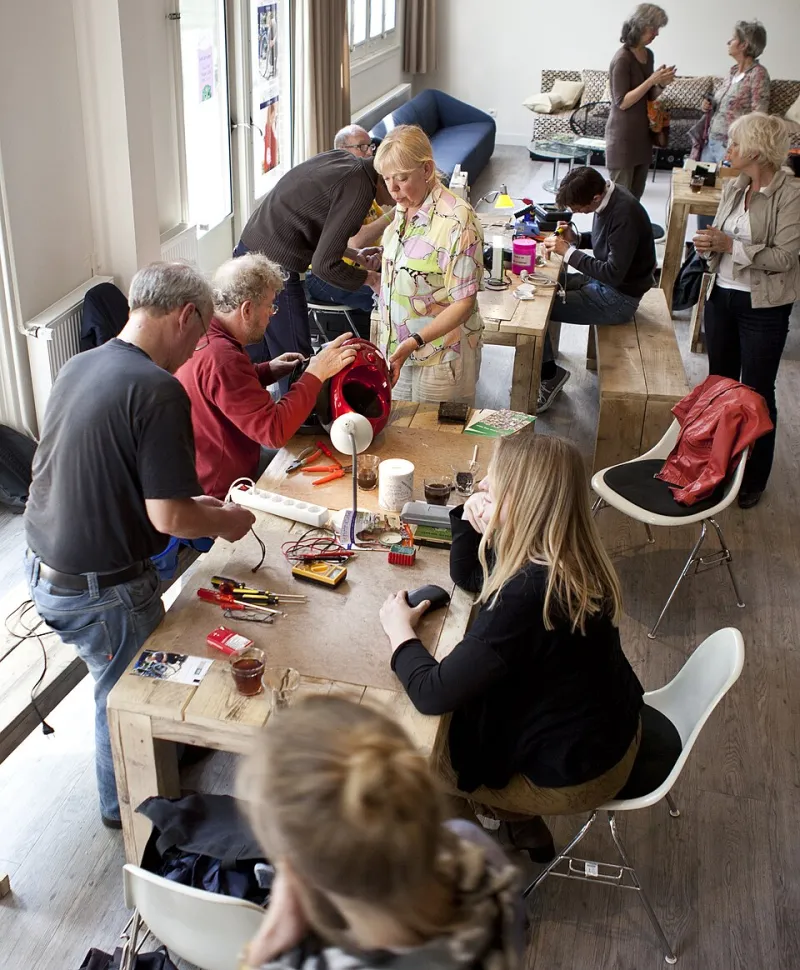
Photo: Ilvy Njiokiktjien, CC BY-SA 3.0, via Wikimedia Commons
Repair cafés have quietly become part of the civic furniture of the United Kingdom. In church halls, libraries and community centres, volunteers sit behind tables with soldering irons, sewing machines and tool kits, trying to keep household objects out of landfill. The movement is practical, social and deliberately unglamorous. It is also, whether it intends to be or not, a cutlery service by default. Knives arrive in carrier bags: blunt, rusted, inherited, handleless or simply neglected. What happens next reveals a gap that Sheffield's cutlery trade should help close.
The Knife at the Repair Table
A volunteer faced with a toaster has a reasonable chance of diagnosis. A volunteer faced with a carbon steel kitchen knife has a different problem. The blade may be blunt, but the cause could be a rolled edge, a badly set bevel, a chip or a handle that has shrunk. Sharpening looks simple and is not. A belt grinder in unpractised hands can overheat a thin edge, alter the profile and remove more steel than the knife can afford. A loose handle may need re-riveting, epoxy or replacement scales. An inherited knife may carry a patina that a well-meaning cleaner mistakes for dirt.
Repair cafés are often sensible about this. Many decline knives altogether, citing safety, insurance or lack of expertise. Others offer a light hone and a conversation. Both responses are understandable. Neither is a system.
Mending Is Not the Same as Cutlery
The repair café ethos is to keep things in use, not to restore them to showroom condition. That ethos is valuable. But a knife is a cutting tool with a geometry, a heat treatment and a handle interface. A repair that makes a knife look better while ruining its edge is not a repair. Similarly, a professional sharpening that ignores the owner's habits may be technically correct and practically useless.
The distinction is not about hierarchy. It is about scope. Community volunteers can clean, tighten, oil, assess and refer. Professional cutlers can grind, re-profile, re-handle and advise. The mistake is to pretend the two roles are interchangeable.
A Sheffield Partnership Worth Trying
Sheffield is the obvious place to test a closer relationship. The city still holds a concentration of cutlery knowledge: makers, sharpeners, handle-makers and retailers who understand carbon steel, stainless steel and the difference between a good edge and a cheap one. A formal partnership with repair cafés could take several forms.
First, a triage clinic. A cutler or experienced sharpener attends a repair café once a month to assess knives and demonstrate basic care. Volunteers learn to distinguish a honing job from a grinding job, and owners learn what not to do.
Second, a referral pathway. Repair cafés could hold a simple list of local sharpening services and pass on knives that fall outside their scope. A collection point, a labelled bag and a clear price would remove friction for people who have never used a cutler.
Third, a skills exchange. Sheffield workshops could train volunteers in safe handling, cleaning, rust removal and basic honing, while repair cafés could teach the trade something about accessibility, welcome and plain language. The trade has deep expertise; the repair movement has reach.
Fourth, a subsidised service for inherited tools. Many people inherit a good knife and have no idea what it is. A low-cost assessment and sharpen, offered through a repair café, would keep useful blades in circulation and introduce new customers to Sheffield work.
The Risks of Good Intentions
None of this is an argument for letting volunteers loose with a grinder. Insurance, safety and competence matter. A partnership should define what is in scope: cleaning, oiling, tightening, light honing, assessment and referral. It should be clear about what is not: regrinding, re-profiling, heat treatment, major handle repair. The cutlery trade should not patronise the repair movement, but it should be honest about the limits of a volunteer table.
There is also a commercial point. Repair cafés are not a threat to cutlery businesses; they are a front door. They reach people who would never search for a sharpening service, who think a blunt knife is simply old, or who are about to buy a replacement because nobody told them the blade could be saved. A referral from a trusted volunteer is worth more than an advertisement.
Why Sheffield Should Lead
The city's name still means something in cutlery. That reputation was built on steel, but it was maintained by service: grinding, sharpening, repairing and re-handling. A partnership with repair cafés would be a modern expression of the same idea. It would improve access, spread basic skills and keep good blades out of the bin. It would also give the trade a visible community role at a time when the meaning of 'Sheffield-made' is under constant scrutiny.
The repair café movement has shown that people will queue to have things mended. Sheffield's cutlery trade should be at that table, not merely in the next room. Bring out your blades; there is work for both sides.