Ten Edges in the City: Reading Sheffield on Foot Through Its Cutlery Landmarks
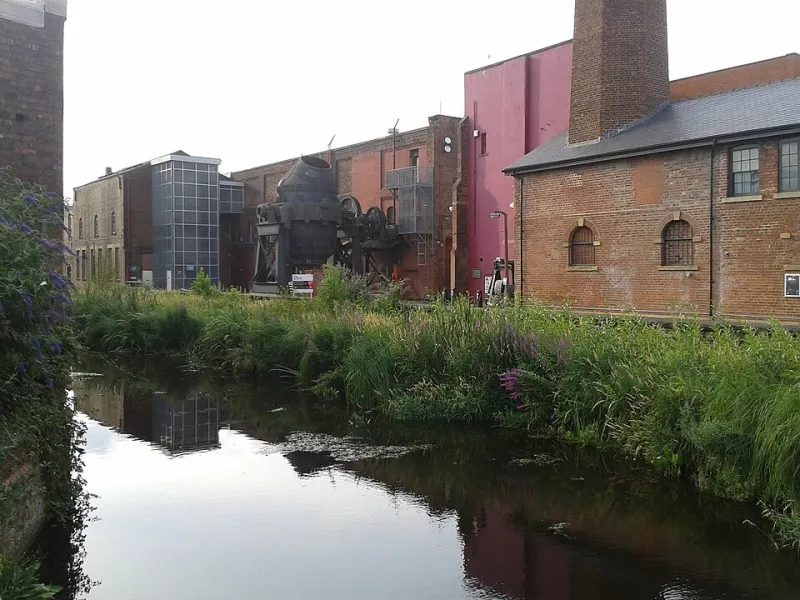
Photo: Warofdreams, CC BY-SA 3.0, via Wikimedia Commons
Sheffield is a city that hides its workshops behind brick and its history behind car parks, and yet the trade remains legible on foot. You do not need a guidebook to see it. You need a pair of boots, an eye for a datestone, and the willingness to look up above the shopfronts.
The ten stops below can be done across a long weekend or, with discipline, two decent days. They run roughly from the cathedral quarter out along the Don to Kelham Island, then south-west up the Porter and the Sheaf. Check opening times before travelling: several of the best sites are volunteer-run and keep limited hours.
1. Cutlers' Hall, Church Street
Start where the trade governed itself. The Company of Cutlers in Hallamshire was incorporated in 1624, and the present hall, with its giant cutlery frieze and its stainless steel door, dates from 1832. It is not generally open to the public, but the façade is free to read and rewards five minutes of standing still: the urns, the crest, the sheer civic confidence of a trade that thought of itself as a third estate.
Watch for Heritage Open Days each September, when the hall and its silver collection open their doors.
2. The grid of Little Sheffield
Walk south-east to Arundel Street, Sylvester Street, Matilda Street, Sidney Street and Eyre Street. This grid was laid out in the late eighteenth and early nineteenth centuries as a working quarter of small workshops and back-to-back housing, and it remains the best place in Britain to read a metal trades district in the street plan itself — narrow frontages, courtyards behind, works named on the gateposts.
Look for the surviving painted signs and the occasional wheel-arch wide enough for a grindstone.
3. Butcher Works, Arundel Street
The Butcher Works once housed a steam-driven grinding wheel serving dozens of small masters, and its converted shell — now studios and flats — still shows the tall windows and internal courtyards of a purpose-built cutlery manufactory. Stand in the archway and consider that a single water or steam wheel here could keep twenty families in work.
4. Portland Works, Randall Street
A short walk south brings you to Portland Works, purpose-built in the 1870s for the metal trades and, crucially, still full of small makers rather than show flats. It is one of the last working examples of the courtyard works in the city, and open days give a rare chance to see lathes, forges and benches in something close to their original arrangement.
This is the stop that answers the question every visitor asks: is anything still made here?
5. Cornish Place, off Green Lane
James Dixon and Sons built a metalwork empire here, and the surviving ranges of Cornish Place — now residential — retain the scale and rhythm of a nineteenth-century works. Approach from Green Lane and you get the long elevation, the chimney and the sense of a firm that could supply an empire with teapots, spoons and surgical instruments alike.
6. Kelham Island Museum, Alma Street
The essential stop. Kelham Island holds the River Don Engine, a rolling mill engine of immense power that is steamed on advertised days, along with displays on crucible steel, the Bessemer process and the city's edge tool trade. Allow two hours rather than one.
The Hawley Collection, held here, is the trade's conscience: thousands of tools and knives gathered by Ken Hawley, catalogued and shown as evidence rather than ornament. For anyone who has ever wondered how a spring knife was hafted, this is the answer, in drawers.
7. A pause on Alma Street
The Fat Cat and the Kelham Island Tavern sit a few minutes from the museum, both in buildings that have watched the district change from foundries to flats. Neither is a cutlery museum, and that is the point: have a pint, read the pump clips, and notice that the street layout beneath your feet is the same one the wheels and the wagons used.
8. Shepherd Wheel, Whiteley Woods
Take the bus or the tram south-west and walk into the Porter valley. Shepherd Wheel is a grinding hull — a water-powered workshop — on a site worked since at least the sixteenth century, restored and run by volunteers. The wheel turns, the stones sit in their housings, and the whole business of holding a blade against a spinning gritstone becomes suddenly, physically obvious.
Opening is limited and weather-dependent. Check before you set out, and wear something that can handle mud.
9. Abbeydale Industrial Hamlet, Abbeydale Road South
Further up the Sheaf, Abbeydale is a complete edge tool works: crucible furnace, tilt hammers, grinding shop, the lot, with water still driving the machinery on demonstration days. It is the closest thing in England to walking into a working nineteenth-century scythe manufactory, and the contrast with the city-centre conversions is bracing.
10. Women of Steel, Barkers Pool
Finish back in the centre, in front of the bronze figures by Martin Jennings unveiled in 2016. The sculpture commemorates the women who took the heavy work in Sheffield's steelworks during the Second World War, and it closes the walk properly: the trade was never only cutlers, and never only men.
Practical notes
Much of this route is on paved ground, but the Porter and Sheaf sections need proper footwear. The city-centre stops cluster within fifteen minutes of each other; the valley sites need a bus, a tram or a car. If you have a spare hour, the Crucible Theatre on Tudor Square takes its name from Huntsman's crucible steel and makes a decent coffee stop between stops two and three.
Above all, look up. The trade wrote itself into lintels, chimneys and gateposts, and much of it survives precisely because nobody bothered to remove it.