Reading the Lot Before the Gavel: A Cautious Buyer's Notes on Second-Hand Sheffield Blades

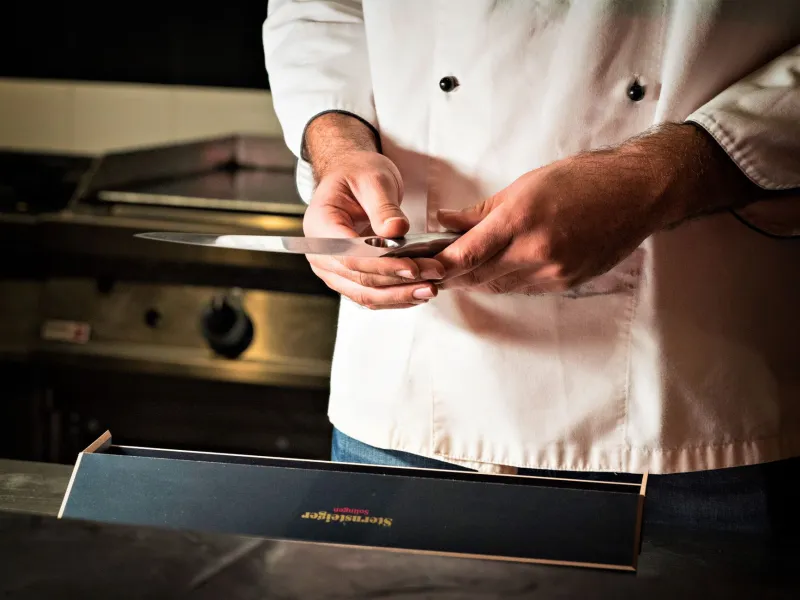
Photo by Photo by EMANUELE Ricciardi on Unsplash on Unsplash
There is a particular kind of disappointment that follows a good lunch at a provincial saleroom: a boxed lot of "vintage Sheffield knives" bought on the strength of a typed label, opened at home to reveal three blades of uncertain parentage, one cracked scale and a ferrule that has clearly spent forty years attached to something else. The knives are not worthless. They are simply not what the label promised.
Sheffield's name is one of the most heavily borrowed in the cutlery trade. It appears on knives made in the city, on knives made elsewhere under licence, on knives finished here from imported blanks, and on knives that have no connection to the place at all. The secondary market — auction rooms, antiques centres, car boot sales and the sprawling classified sites online — is where those distinctions are finally tested. It is also, for the patient buyer, the last place where a well-made working knife can be had for less than the cost of a modest dinner.
The two outcomes depend almost entirely on how much work you do before the hammer falls.
What the Lot Photograph Cannot Tell You
Online catalogues have transformed the auction trade, mostly for the better and occasionally for the worse. A single well-lit photograph of a knife laid flat on a grey cloth will show you the shape of the blade and the colour of the handle. It will not show you the depth of a rust pit near the bolster, the wobble in a ferrule, or the thinness of a blade that has been ground back over decades of enthusiastic sharpening.
Where a saleroom offers a public viewing, attend it. Take a small magnifying glass — a jeweller's loupe is better — and a scrap of paper on which to note lot numbers. Handle the knife with permission, close the blade yourself, and check the action. A blade that will not sit squarely in the channel when closed has either been bent or badly re-handled, and neither fault is cheap to correct.
If viewing is impossible, ask the saleroom for additional photographs: the spine, the mark, the inside of the handle scales, and the point where the blade meets the bolster. Reputable houses will oblige. A house that will not is telling you something useful.
Marks: Less Decisive Than They Appear
Beginners tend to treat the tang stamp as a certificate of authenticity. It is better understood as a clue. Sheffield's great names — Rodgers, Wostenholm, Mappin, Harrison Fisher, Taylor's Eye Witness among them — produced millions of knives over more than two centuries, and their marks have been reproduced, licensed, sold on and, in some cases, applied to blades of entirely different origin.
A few principles are worth keeping in mind. A stamp reading "Sheffield Steel" describes a material, not a place of manufacture. The words "Sheffield, England" on a blade made after the 1890s are consistent with export practice, when country-of-origin marking became a requirement for goods entering the United States, but they do not by themselves prove the knife was made in a Sheffield workshop. And a mark that is crisp and deep on a blade that is otherwise worn smooth is a contradiction worth investigating.
What you are looking for is coherence. The mark, the grind, the handle material and the style of the fittings should all belong to roughly the same period and the same tradition of making. Where they do not, you are probably looking at a knife assembled from parts — a common practice in the trade, sometimes honestly and sometimes not.
The Grind Tells the Truth About Use
Blades speak more plainly than stamps. A Sheffield kitchen knife of the twentieth century will usually show a flat or slightly hollow grind running from spine to edge, with a secondary bevel at the very edge. Look at the width of that bevel. A narrow, even bevel suggests light domestic use and careful maintenance. A wide, uneven one, with the blade visibly thinner behind the edge than it should be, indicates repeated sharpening — often on a grinding wheel by someone in a hurry.
Check the spine for a straight line. Check the tip: a blade that has lost its point to a dropped tip or an over-enthusiastic session on a belt grinder can be reprofiled, but the result is a shorter knife than the one in the photograph.
Pitting is the other honest witness. Carbon steel left damp will pit, and deep pits near the edge are a functional problem rather than an aesthetic one — they can turn into chips in service. Surface staining is cosmetic and easily dealt with. Pitting that catches a fingernail is not.
Handles, Fittings and the Assembled Knife
On older Sheffield knives, the handle is where repairs show. Look at the fit of the scales against the tang. A gap, a proud pin, or a mismatched pair of scales suggests replacement, which is not necessarily disqualifying — a rehandled knife with good steel is often excellent value — but it should be priced accordingly.
Stag and bone were used for generations, with hardwood, ebony and, later, synthetic materials. Beware of a handle so uniformly perfect that it looks new against a blade that plainly is not; and beware, equally, of a handle described as stag that is in fact pressed and dyed bone.
Examine the ferrule and bolster for solder lines and file marks — the signature of a repair. A knife that has been rehandled once can be a bargain. A knife that has been rehandled three times, each time with a little less care, is a project.
The Money Question
Auction arithmetic deserves more respect than it usually gets. Buyer's premium commonly runs between 20 and 30 per cent on top of the hammer price, and VAT may apply to the premium and sometimes to the lot. Postage and packing on a heavy box of knives is rarely trivial. A knife that looks like good value at £40 can land at £65 before it reaches your door.
Set a ceiling before you bid, write it down, and treat it as fixed. There is no shortage of Sheffield knives in the world; there is only a shortage of patience.
Questions Worth Asking
Before bidding, satisfy yourself on the following: Has the blade been reground, and by whom? Are the handle scales original? Is the mark legible in the hand as well as in the photograph? Is there movement in the fittings? Does the vendor's description of age match the style of the make? And, most importantly: would you be content with this knife if every claim on the label turned out to be wrong?
If the answer to the last question is yes — if the steel is sound, the geometry sensible and the price fair — then you have bought a tool rather than a story. That is the whole art of it. Sheffield's heritage is best served not by the pieces kept behind glass, but by the knives that go back to work.