The Kitchen Doesn't Read the Spec Sheet: A Sheffield Blade in Professional Service
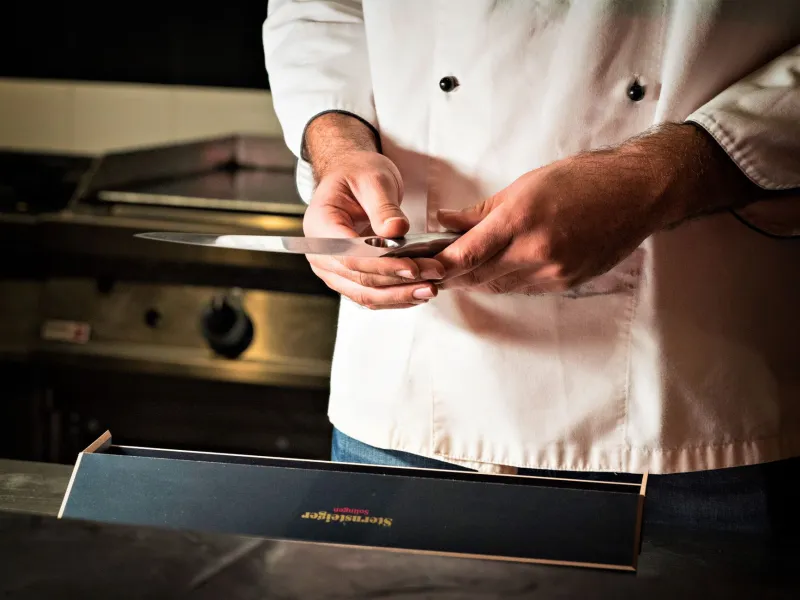
A knife can look convincing on a workshop bench and still disappoint at the pass. The bench rewards symmetry, finish and a controlled sharpening routine; a working kitchen asks for speed, consistency and tolerance of human error. To test that gap, Sheffield Cutlery followed one Sheffield-made 20 cm chef's knife from a small workshop into a busy 70-cover British restaurant in Manchester for six months in 2026. The maker supplied a standard pattern rather than a special prototype, and the head chef agreed to record how the blade wore, sharpened and performed. Neither party paid for the exercise.
The Maker's Brief
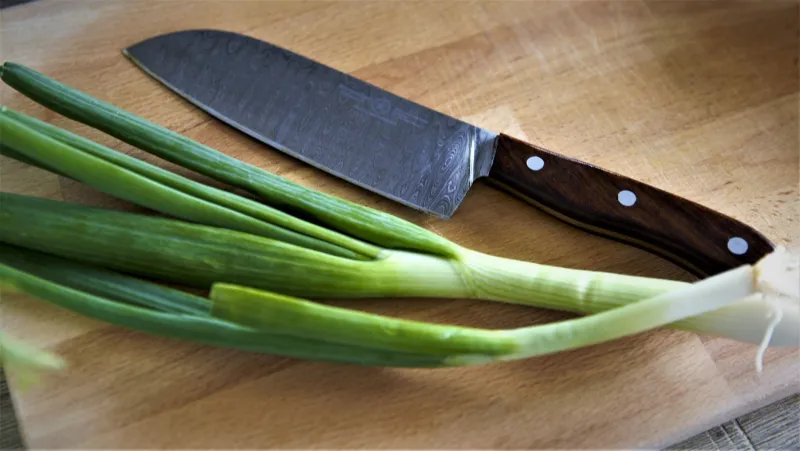
The knife was intended as a general-purpose professional blade. Its maker specified a high-carbon stainless steel, a target hardness of 59–60 HRC, a distal taper through the blade, an eased spine and a full tang under stabilised oak. The grind was intended to balance food release with enough behind the edge to survive daily board work. On the bench, the knife cut cleanly and felt lively. The maker's assumption was that a professional cook would value the same qualities: a keen edge, a comfortable handle and steel that responded well to maintenance.
The chef's first response was more pragmatic. The balance was good and the blade felt familiar in a pinch grip, but the handle was described as handsome rather than kitchen-ready. Oiled oak looks well in a workshop photograph; in a wet service, it can become slick. The maker had thought about comfort. The chef was thinking about a twelve-hour shift, a wet cloth and a hand that never quite dries.
First Weeks: Volume Changes the Question
The knife entered service during a period of ordinary restaurant pressure: onions, shallots, herbs, tomatoes, root vegetables and the occasional butchery task. The chef kept it for personal use rather than putting it into a shared knife roll, which removed some variables but not the central one. A working kitchen does not use a knife gently. It uses it repeatedly, quickly and sometimes carelessly.
Initial edge retention was strong. After the first week, the blade still cut tomatoes cleanly and showed no chipping. By the end of the second week, the edge had dulled noticeably near the heel, where the chef tended to apply pressure during rock chopping. This was not a failure of steel or heat treatment. It was a lesson in how technique concentrates wear. The maker had designed a general-purpose edge; the kitchen had found the part of it that did most of the work.
The first sharpening came at the end of week three. The chef used a whetstone, kept the angle slightly more obtuse than the maker's recommended angle and raised a burr quickly. The steel responded well. The edge came back without fuss, which matters more in a commercial setting than a laboratory figure on a specification sheet. A knife that is easy to restore is a knife that stays in use.
Geometry Under Pressure
The most useful feedback concerned geometry rather than metallurgy. The chef liked the blade height and the flat section through the middle, which suited the controlled push-cut used for onions and herbs. The tip was fine enough for shallots but needed care around dense root vegetables. The spine, eased at the factory, remained comfortable during long prep sessions. The heel, however, was less forgiving. After a month, the chef reported that the transition from bolster to edge encouraged a slightly heavy hand when the knife was used near the board's edge.
The handle divided opinion. It remained tight and showed no movement at the rivets, but the oak needed re-oiling after the first month. In a domestic kitchen that is a small ritual. In a professional kitchen it is an inconvenience. The chef did not want a handle that required attention; the chef wanted a handle that could be wiped, washed and ignored. The maker's view was that natural materials reward care. Both views are reasonable. The commercial buyer is entitled to know which one the knife has been designed for.
Six Months On
By the end of the six months, between May and October 2026, the knife had been sharpened fourteen times. It had lost a small amount of blade height at the heel, as any working knife will, and carried the scratches and small marks of daily board contact. The edge had never chipped badly. It had rolled once after contact with a metal tray, a reminder that no kitchen knife is designed for every surface it will meet. The handle had darkened and required re-oiling twice. The blade remained straight, the rivets remained tight and the steel showed no staining.
The chef's verdict was neither a rejection nor a celebration. The knife was good, useful and pleasant to sharpen. It was not yet a kitchen knife in the full commercial sense because it asked for more care than a busy brigade naturally gives. The maker's verdict was more nuanced. The exercise confirmed the steel and the grind. It exposed the handle finish and the absence of clear guidance on sharpening angles and daily maintenance. In a workshop, those are details. In service, they are the difference between a knife that is admired and a knife that is trusted.
What the Trade Can Learn
The first lesson is that commercial kitchens buy outcomes, not intentions. A chef needs an edge that returns predictably, a handle that survives washing and a blade geometry that suits the way the kitchen actually cuts. The second is that maintenance must be designed into the product. A Sheffield maker can reasonably ask a chef to sharpen on a stone, but the maker should say so plainly and provide an angle, a routine and a realistic expectation of edge life. The third is that testing should happen in service, not only at the bench. A week in a real kitchen will reveal more about handle finish than a month of workshop inspection.
For buyers, the practical questions are straightforward. Ask what the knife is designed to do, how it should be sharpened and what the handle will look like after a year of washing. Ask whether the maker expects the blade to be maintained by a professional service or by the cook. Ask for the steel, the hardness and the grind, but do not stop there. A specification sheet can describe a knife. Only service can reveal whether it belongs in a working kitchen.
The Sheffield trade has long understood that a good blade is a partnership between maker and user. This exercise did not undermine that idea. It sharpened it. The kitchen does not read the spec sheet. It uses the knife, day after day, and returns a verdict that no workshop can ignore.