Between Order and Edge: Reading the Queue for a Sheffield Kitchen Knife in 2026
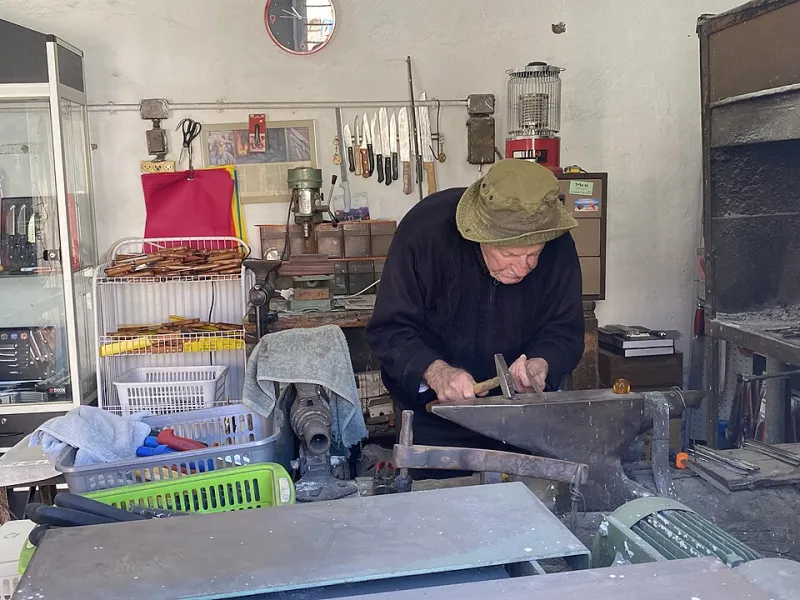
Photo: שלמה רודד, CC BY 2.5, via Wikimedia Commons
There was a period, not so long ago, when a Sheffield kitchen knife was a thing you bought rather than a thing you joined. You chose it, paid for it, took it home. That transaction still exists — the workshop shelf, the market table, the small stock of finished blades — but it now sits alongside a second and increasingly dominant mode of purchase: the commissioned knife, secured by deposit and delivered after a wait measured in seasons rather than days.
The change is not merely commercial. A lead time is a statement about a bench, a pair of hands and the number of hours in a week. Read carefully, it is one of the more honest disclosures a maker can offer. Read carelessly, it is one of the easiest claims to inflate. The purpose of this guide is to help the buyer tell the two apart.
Why the Queue Grew
Sheffield knife-making in 2026 is, for the most part, a small-team activity. A workshop of two or three people, working with a grinding wheel, a heat-treatment schedule and a finishing bench, will produce a bounded number of kitchen knives each month. That number does not rise simply because enquiries do. Grinding and finishing are not easily subcontracted without surrendering the very qualities a buyer is paying for, and the pool of people who can run a blade to a consistent geometry is small — a point this site has examined before in the context of succession.
Demand, meanwhile, has broadened. The domestic kitchen has become more ambitious; the professional kitchen more interested in British-made tools; the gift market more willing to spend. The consequence is a structural gap between the number of enquiries a Sheffield bench attracts and the number of knives it can complete.
A queue is the rational response to that gap. It is also, it should be said plainly, a useful marketing device. Both things are true at once.
What a Lead Time Actually Measures
A quoted lead time is usually a calendar estimate, not an arithmetic one. The distinction matters. An arithmetic lead time can be derived: hours of bench work per knife, multiplied by the number of knives ahead of yours, divided by the hours the workshop devotes to commissions each week. Ask a maker to walk you through roughly that calculation and the answer will tell you a great deal — about their honesty, their workload, and whether the figure they first gave you was considered or conventional.
Buyers should also separate two things that are often conflated: queue position and delivery window. A position in a queue is a promise about sequence. A delivery window is a promise about dates. The first is far more reliable than the second, because batching, heat-treatment cycles, material sourcing and the ordinary unpredictability of a small business all compress and stretch the calendar.
A maker who says, in effect, that you are fourth in line and should expect the work to begin in the spring, is offering a more useful statement than one who promises a specific Friday in June.
Deposits: What You Are Actually Paying For
Most Sheffield commissions now require a deposit, commonly in the region of twenty to fifty per cent, sometimes staged across specification, commencement and completion. There are legitimate reasons for this. Specialist handle material — stabilised timber, horn, synthetic composites — is often bought in for a specific knife and cannot be returned. A deposit also protects a maker against the cost of a client who changes their mind after the blade has been ground.
Buyers should nevertheless be clear about three questions before any money moves.
First, is the deposit refundable, and under what conditions? Under the Consumer Rights Act 2015, goods made to a consumer's specification may fall outside the fourteen-day cancellation right that otherwise applies to distance sales. That is a legitimate exemption, but it is not a licence for vague terms. Ask for the policy in writing before you pay.
Second, what happens if the maker cannot deliver? Small workshops do close. Illness, retirement, premises, the cost of electricity — all of these have ended Sheffield businesses before. A deposit is unsecured credit unless it sits in some form of protected arrangement, and buyers commissioning work of several hundred pounds should ask, without embarrassment, what provision exists.
Third, when does the specification freeze? A deposit paid against an unagreed specification is a deposit against an argument.
Reading a Queue Without Being Seduced
The signals of a genuine order book are unglamorous and specific. A dated confirmation of your slot. A written quotation that names the steel, the stock thickness, the blade length and the handle material. A named person responsible for the work. A stated cadence for updates. Photographs at agreed milestones rather than a flurry at the end. Terms that survive being read aloud.
The signals of a queue used as theatre are equally recognisable. An indefinite "waiting list" with no position attached. A deposit requested before any specification is discussed. A price left open until completion. A maker who answers a question about lead times promptly but a question about steel slowly — or not at all.
None of this is unique to Sheffield, but Sheffield buyers have a particular advantage: the trade is compact and traceable. A workshop's reputation travels through a short corridor of grinders, sharpeners, retailers and repairers. Ask around. The answer is usually available.
The Scarcity Trap
It is worth stating the unpopular thing. A long waiting list is not evidence that a knife is good. It is evidence that a maker is busy, which may reflect quality, marketing, a small bench, or all three in unknown proportion.
Intending buyers should hold a queue in the same regard as any other claim on a specification sheet: as something to be verified rather than admired. Compare the commissioned option against finished stock in a Sheffield retailer, against the second-hand market, and against makers quoting eight weeks rather than eighteen. Sometimes the shorter queue is the better knife. Occasionally the longer one is. The queue itself cannot tell you which.
What Patience Genuinely Buys
The honest case for waiting is not mystique; it is specification. Time at the bench allows a knife to be made to your board, your grip and your cooking. Blade length, heel height, distal taper, grind, handle shape and handedness can all be set by conversation rather than compromise. A left-handed cook, a baker working with a deep bench, a professional who wants a specific edge profile — these are buyers for whom a commission earns its delay.
That is what patience purchases: not exclusivity, but fit.
A Short Checklist Before You Join a Queue
- A written quotation naming materials, dimensions and price.
- A stated queue position and an expected start window.
- Deposit terms, refund conditions and a specification freeze date, all in writing.
- A named maker and a communication schedule.
- A clear answer on what happens if the workshop cannot complete the work.
- Realistic tolerance on delivery, agreed in advance.
A queue, properly documented, is a decent thing: a small manufacturer telling the truth about capacity. Improperly documented, it is a hope with a receipt attached. The buyer's task in 2026 is not to avoid waiting, but to know precisely what the wait is for.